
Table of Contents
Security Operations and Counterterrorism Efforts
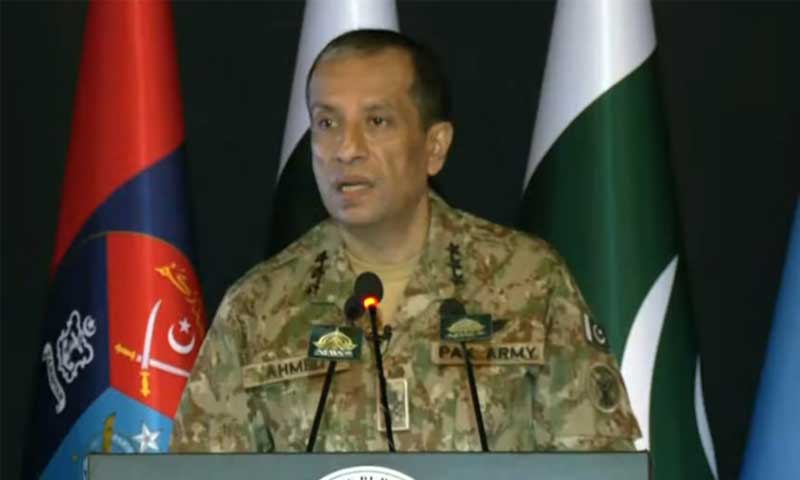
Director General Inter-Services Public Relations (ISPR) Lieutenant General Ahmed Sharif Chaudhry held a press conference today to brief the media on the security situation and ongoing counterterrorism operations across Pakistan . Speaking extensively, he provided a comprehensive overview of the country’s security landscape, particularly focusing on Balochistan and Azad Jammu and Kashmir.
The DG ISPR revealed that security forces have conducted 40,348 intelligence-based operations across Pakistan so far this year, averaging nearly 194 operations daily . More than 31,000 of these operations were carried out in Balochistan, reflecting the state’s continued focus on restoring peace in the province .
According to military figures, 2,084 confirmed terrorists have been eliminated during 2026, averaging nearly 10 militants killed each day—described as the highest operational ratio in the country’s history . The operations resulted in the deaths of 303 Pakistan Army personnel, 194 members of law enforcement agencies, and 322 civilians . A total of 3,145 terrorism-related incidents were recorded nationwide, including 28 suicide bombings .
Balochistan Situation and Development Narrative
Addressing claims of deprivation in Balochistan, the DG ISPR argued that the province has received substantial development investment, pointing to infrastructure, hospitals, roads, recreational facilities, and an international airport in Gwadar as examples . He noted that Balochistan’s per capita income is higher than several other provinces .
Lt Gen Chaudhry alleged that terrorist groups deliberately target development projects—including roads, schools, and other infrastructure—to obstruct progress and create a false narrative of neglect . He maintained that terrorist organizations opposed to development in Balochistan attack soft targets such as trains and then flee, later claiming that no development is taking place .
He described the province’s fundamental issue as the tribal “sardari” system, which he said preserves a status quo where poor families’ children are prevented from education and progress . He argued that this mindset, of having rights without duties, was the core driver of terrorism in Balochistan.
AJK Situation and Kashmir Policy
Regarding Azad Jammu and Kashmir, the DG ISPR described Pakistan as an ideological state and Kashmir as Pakistan’s “most beloved child” . He said Pakistan had demonstrated generosity and commitment toward Kashmir, and that the decision of the Kashmiri people was settled “in their DNA.”
The DG ISPR alleged that India had tried three approaches in occupied Kashmir—appeasement, militarization, and legal maneuvers—none of which had succeeded in extinguishing the Pakistani spirit in the region . He maintained that Pakistan’s position had been made clear in 2019 and reaffirmed by 2025.
Definition of ‘Hard State’ and Governance
Clarifying the concept of a “hard state,” Lt Gen Chaudhry said it does not refer to military dominance but rather a system where the Constitution and law are applied equally to every citizen without discrimination or elitism . He urged citizens to balance rights with constitutional responsibilities, citing Article 5 of the Constitution which establishes loyalty to the state as a fundamental obligation .
He posed the question: “Is it not the duty of every citizen that our first and last identity should be Pakistani?” and emphasized that citizens should not prioritize tribal or ethnic identity over national identity .
On governance reforms, he noted that Pakistan’s population had grown from 6-7 crore to 25 crore while still having the same four provinces, suggesting that administrative reform needed serious discussion through constitutional and democratic processes .
