
Table of Contents
Astronomers have made a groundbreaking discovery with the first-ever near-infrared analysis of an extragalactic recurrent nova, LMCN 1968-12a. Located in the Large Magellanic Cloud (LMC), a satellite galaxy of the Milky Way, this nova is now considered the hottest of its kind ever observed. The discovery sheds new light on the extreme conditions and unique chemical properties of this violent astronomical event.
LMCN 1968-12a is not just notable for its intense heat, but also for its distinct chemical makeup, which differs significantly from other nova explosions observed within the Milky Way. The research, published in Monthly Notices of the Royal Astronomical Society, emphasizes the rarity and significance of studying a nova in near-infrared light, providing a deeper understanding of these powerful cosmic occurrences.
AI Startup Perplexity Eyes TikTok Acquisition, Promises Open-Source Algorithm
Understanding Novas and Their Formation
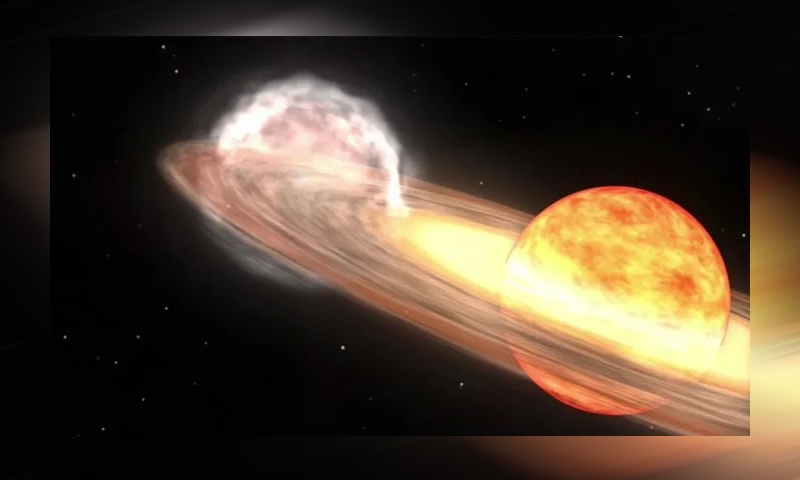
A nova occurs when a white dwarf, the remnant core of a collapsed star, is in a tight orbit around a companion star. The gravitational pull from the white dwarf draws material from its companion, leading to a dramatic and explosive event known as a nova. The resulting explosion causes a sudden, bright flash of light, often referred to as a “new star” in the sky, which can last for weeks or months before gradually fading. Unlike a supernova, which marks the death of a star, a nova leaves the original stars intact, with only the outer layers of the white dwarf undergoing the explosive event.
Unique Properties of LMCN 1968-12a
What makes LMCN 1968-12a particularly extraordinary is not only its extreme temperature but also the chemical signatures that were detected in the near-infrared spectrum. These findings indicate that the nova’s eruption is unlike those observed in our galaxy, suggesting that the conditions in the Large Magellanic Cloud may be different from those in the Milky Way, leading to distinct nova behaviors. This presents an exciting avenue for future astronomical studies, offering insights into how stellar systems in different galaxies might evolve and behave.
The Importance of Near-Infrared Observations
This discovery marks the first time that a recurrent nova outside our galaxy has been observed in near-infrared light, a technique that allowed researchers to study the event with unprecedented detail. By observing the nova at these wavelengths, scientists were able to capture a clearer picture of the explosion’s extreme temperatures and unique chemical properties, providing valuable data that could challenge and refine our understanding of nova mechanisms across different galaxies.
