
Table of Contents
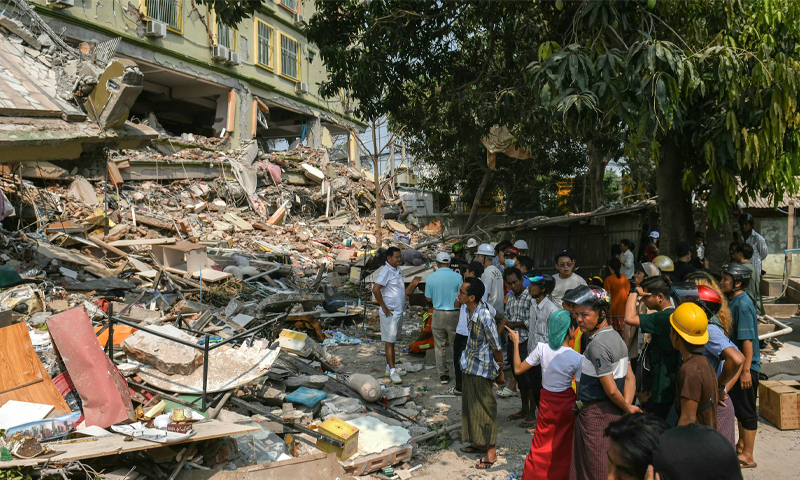
A 7.7-magnitude earthquake struck Myanmar on Friday, one of the strongest quakes the country has experienced in a century. The tremor left widespread destruction, particularly in central and northwestern Myanmar, including major urban centers like Mandalay and Naypyitaw. The human toll has been staggering, with the latest reports indicating around 1,700 dead, 3,400 injured, and over 300 still missing.
The devastation has also brought the country’s fragile infrastructure to its knees. Bridges, roads, airports, and railways have been heavily damaged, making it difficult for rescue teams to reach affected areas. Myanmar’s healthcare system, already strained by ongoing civil conflict, has been overwhelmed by the number of injured, and many hospitals are operating at full capacity. In some towns, such as Sagaing, local hospitals are unable to treat the growing number of casualties due to a lack of medical supplies and resources.
International Aid and Rescue Teams Mobilize
In the wake of the disaster, several neighboring countries have stepped forward with offers of aid. India, China, and Thailand, along with countries like Russia, Singapore, and Malaysia, have dispatched relief materials and teams to assist in the rescue efforts. The United States has pledged $2 million in aid through Myanmar-based humanitarian organizations, and USAID has sent an emergency response team to help with recovery operations.
Despite these efforts, many parts of Myanmar remain isolated. The destruction of vital infrastructure has slowed down the movement of relief supplies, and rescue teams have been hampered in their ability to access affected areas. According to the International Federation of Red Cross and Red Crescent Societies, the destruction is “extensive,” and the humanitarian needs are growing by the hour. As temperatures rise and the monsoon season nears, there is an urgent need to stabilize affected communities before secondary crises, such as disease outbreaks, worsen the situation.
Struggling with Limited Resources
In the most heavily affected areas, such as Sagaing and Mandalay, residents have reported that they have received little to no aid. Local efforts have been largely self-organized, with some communities relying on basic tools and limited manpower to search for survivors. In Sagaing, a major bridge connecting the town to Mandalay collapsed, leaving residents with limited access to external assistance.
The lack of government response in certain areas has left many people to fend for themselves. Han Zin, a resident of Sagaing, described the situation as dire. “What we are seeing here is widespread destruction — many buildings have collapsed into the ground,” he said. “We have received no aid, and there are no rescue workers in sight.” Many areas are also suffering from power and water shortages, exacerbating the crisis.
Overwhelmed Hospitals Struggle to Cope
Hospitals in Mandalay and Naypyitaw, Myanmar’s second-largest city and the capital respectively, are struggling to handle the influx of injured people. According to the UN Office for the Coordination of Humanitarian Affairs, the situation has worsened as both public and private healthcare facilities were damaged in the quake. Hospitals have been forced to treat patients outdoors due to the overwhelming number of injuries.
Local medical teams are working with limited equipment and supplies to treat the injured. One humanitarian worker in Mandalay shared the dire conditions, saying that they are using basic kits, ropes, and work gloves to retrieve people trapped under rubble. Many survivors remain trapped under collapsed buildings, and it is feared that the death toll will continue to rise as rescue operations continue.
UAE Authorities Arrest 10 Pakistani Nationals for Begging
The Impact on the Ongoing Conflict
The earthquake has compounded the already dire situation in Myanmar, where the civil conflict between the military junta and opposition forces has led to widespread suffering. Since the military coup in 2021, Myanmar has been embroiled in a civil war that has displaced over 3.5 million people and further damaged the economy and infrastructure.
The opposition National Unity Government, which represents remnants of the ousted elected administration, announced that anti-junta militias would pause all offensive actions for two weeks to allow for humanitarian aid and rescue efforts. This gesture is seen as a way to alleviate some of the pressure on local communities and allow international aid to reach those in need.
Devastation Beyond Myanmar’s Borders
The earthquake also affected neighboring Thailand, where an under-construction skyscraper in Bangkok collapsed, killing 18 people and trapping dozens more under the debris. Rescue operations have been ongoing in the Thai capital for several days, with teams using drones and sniffer dogs to search for survivors in the rubble.
The tragedy in Myanmar and Thailand highlights the vast scale of the destruction caused by the earthquake and the challenges faced by both local and international rescue teams in providing aid to affected areas.
Looking Ahead: A Long Road to Recovery
The earthquake in Myanmar has highlighted both the vulnerability of the country’s infrastructure and the resilience of its people. As the country grapples with the immediate aftermath, international aid continues to pour in. However, the road to recovery will be long and arduous, and the country will need significant assistance to rebuild its infrastructure and support those who have lost everything.
With the monsoon season fast approaching, the situation in Myanmar remains critical. If aid and rescue efforts are not expedited, the country could face even greater suffering in the weeks ahead. The coming days and weeks will be crucial in determining how quickly Myanmar can recover from this devastating disaster.
