
Table of Contents
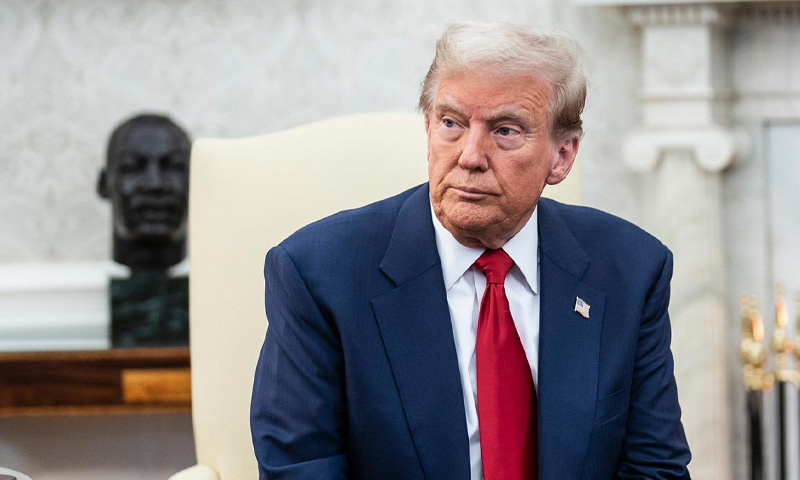
Former U.S. President Donald Trump stated on Monday that U.S. diplomatic intervention was instrumental in stopping what could have been a catastrophic nuclear war between India and Pakistan. His comments came following the announcement of a ceasefire between the two South Asian neighbors after intense cross-border military exchanges.
“We stopped a nuclear conflict. I think it could have been a bad nuclear war—millions of people could have been killed,” Trump said during remarks at the White House. “So I’m very proud of that.”
Ceasefire Follows Deadly Escalation
The ceasefire agreement was reached on Sunday after India and Pakistan engaged in hours of violent exchanges along the Line of Control (LoC), the de facto border in the disputed Kashmir region. Tensions had been running high for days, with both countries accusing each other of unprovoked aggression.
According to Pakistani officials, the country’s armed forces launched a large-scale retaliatory military operation named “Operation Bunyan-um-Marsoos” after Indian forces allegedly carried out missile strikes on multiple Pakistani cities during the night of May 5 and 6. India claimed its actions were in retaliation for the Pahalgam attack in the Indian Illegally Occupied Jammu and Kashmir (IIOJK), which it attributed to cross-border militancy.
While India maintained that its strikes were aimed at terrorist camps, Pakistani authorities reported significant civilian casualties, which prompted an immediate and forceful military response.
Trump Credits Trade and Diplomacy for Peace Effort
Speaking further at a White House event, Trump emphasized that economic interests played a key role in motivating the ceasefire. “Trade is a big reason why they stopped fighting,” he said, suggesting that economic interdependence and U.S. mediation worked together to de-escalate the crisis.
In a post on his social media platform, Truth Social, Trump praised both countries for exercising restraint. “While not even discussed, I am going to increase trade, substantially, with both of these great nations,” he wrote. “Additionally, I will work with you both to see if… a solution can be arrived at concerning Kashmir.”
His message hinted at the possibility of future U.S. involvement in the long-standing Kashmir dispute, a sensitive issue that has sparked several wars and countless skirmishes between India and Pakistan since 1947.
Historical Context: A Region on the Brink
The nuclear-armed neighbors have fought three wars—two of them over Kashmir—and countless border skirmishes over the decades. Both nations conducted nuclear weapons tests in 1998, making any military escalation in the region especially dangerous.
Past ceasefires, such as the 2003 LoC truce, have often collapsed under political or militant pressure. This latest conflict escalated rapidly, and reports indicate that the scale and intensity of military operations on both sides had reached one of the highest levels in recent years.
India and Pakistan often accuse each other of sponsoring cross-border militancy and violating sovereignty, with Kashmir remaining the flashpoint of hostilities. The latest crisis appeared to follow a familiar pattern of accusation, retaliation, and intensifying violence—until the surprise ceasefire was announced.
U.S. Role in Brokering the Ceasefire
While neither New Delhi nor Islamabad has officially confirmed that the United States brokered the agreement, Trump asserted that his administration played a central role behind the scenes. He did not elaborate on what specific diplomatic efforts were undertaken, but characterized the U.S. as a neutral party committed to peace and stability in South Asia.
Pakistan Clarifies It Did Not Seek Ceasefire, Delivers ‘Two-Notch’ Response to Indian Aggression
“America wants peace, not war. Especially nuclear war,” Trump added.
The claim comes amid a broader push by the former president to reassert his influence in international affairs following his re-election earlier this year. Trump had previously attempted to mediate the Kashmir conflict during his first term but was rebuffed by India, which has long maintained that the issue is a bilateral matter.
Regional and Global Reactions
So far, reactions from world capitals have been cautious but supportive. China and the United Nations both welcomed the ceasefire and called for continued dialogue. Financial markets across Asia also responded positively, with regional indices ticking upward on hopes that a wider regional conflict had been averted.
Indian and Pakistani media, however, reflected sharply contrasting narratives. Indian outlets focused on what they termed preemptive strikes against terror infrastructure, while Pakistani media highlighted the disproportionate impact on civilian areas and praised the precision of their military response.
Outlook: Ceasefire Holds, But Underlying Tensions Remain
While the ceasefire appears to be holding for now, experts warn that without a long-term political solution—particularly regarding Kashmir—the risk of renewed hostilities remains high. The LoC continues to be one of the most militarized borders in the world, and even small provocations can quickly spiral out of control.
For now, the focus has shifted to diplomacy. The U.S., under Trump’s leadership, appears ready to play a more active role in facilitating dialogue. Whether this truce evolves into lasting peace or becomes another brief pause in a cycle of conflict remains to be seen.
