
Table of Contents
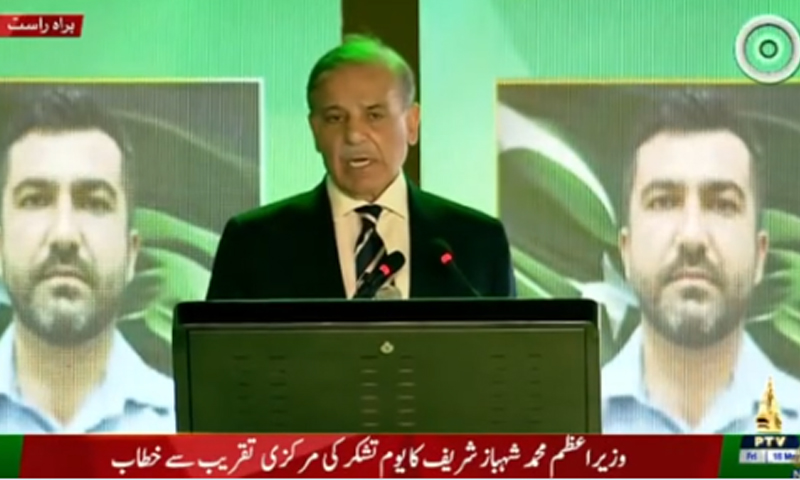
At a national ceremony held at Islamabad’s Pakistan Monument, Prime Minister Shehbaz Sharif celebrated the success of Operation Bunyanum Marsoos and Marka-e-Haq, marking what he called a decisive victory over Indian aggression last week. The event coincided with Youm-e-Tashakur (Thanksgiving Day), observed nationwide to honor the armed forces and the people of Pakistan.
“Today is a day that comes once in centuries,” PM Shehbaz proclaimed, addressing a crowd of military officials, government leaders, diplomats, and citizens. He paid tribute to martyrs and their families, calling their sacrifices a foundation for Pakistan’s enduring strength.
“No Power Can Now Block Pakistan’s Position of Strength”
PM Shehbaz declared that Pakistan now holds a position of strength on the global stage, supported by a united nation and battle-proven armed forces. “No major power can block us now,” he said, highlighting the unity of Pakistanis in response to the recent escalation with India.
Details of Military Response: Rafale Jets Downed, Missiles Launched
Detailing the events of the conflict, PM Shehbaz claimed that six Indian aircraft were downed, including Rafale and MiG fighter jets, during Pakistan’s counteroffensive. He referenced a conversation with COAS General Syed Asim Munir, who urged him to permit a response that would “slap the enemy in the face.”
“Following that, Pakistan launched air strikes on Pathankot, Udhampur, and other key Indian positions, supported by precision strikes from Al-Khalid missiles,” the Prime Minister revealed.
Rejected Peace Offer, Escalating Hostilities
According to the PM, prior to the escalation, Pakistan had offered to form an international investigative committee to probe the Pahalgam attack, which India attributed to Pakistani elements. “Our offer was rejected out of arrogance and pride,” he said, blaming India for choosing aggression over diplomacy.
Global Hunger Crisis Reaches Record High in 2024 Amid Conflict and Aid Cuts
He described the Indian strikes as targeting innocent civilians, including children and elderly people, and said Pakistan had no choice but to retaliate to protect its sovereignty.
Global Reaction and Support for Pakistan
PM Shehbaz thanked friendly nations like Iran, Saudi Arabia, UAE, Turkiye, and China for their diplomatic efforts and support for Pakistan’s stance during the crisis. He also acknowledged US President Donald Trump, crediting him with having the vision and bravery to help de-escalate tensions and push for peace.
“It was Trump’s strategic approach that helped avert a full-blown war,” he said.
Emphasis on Peace Despite Victory
Despite celebrating what he described as a military triumph, PM Shehbaz emphasized that Pakistan desires peace, not prolonged conflict. He stressed that the two nuclear-armed nations had approached a dangerous flashpoint, and only divine intervention and diplomacy prevented catastrophe.
“We have won the war, but we want peace. We taught the enemy a lesson but condemned aggression,” he asserted.
Call for Dialogue on Kashmir and Water Issues
The Prime Minister reiterated Pakistan’s willingness to engage in dialogue with India to address Kashmir, water-sharing, and other core issues. He emphasized that lasting peace is only possible through resolving these disputes.
“We are permanent neighbors—like it or not. We must choose between being unruly or peaceful neighbors,” he said.
Pakistan’s Sacrifices in the Fight Against Terrorism
Highlighting Pakistan’s battle against terrorism, PM Shehbaz revealed the staggering cost: over 90,000 lives lost and $150 billion in economic damages. He stressed that Pakistan has made these sacrifices not just for itself, but for global peace.
“When was the last time any nation paid this kind of price for the world’s safety?” he asked.
Aerial Display and National Tribute
The ceremony opened with a Quranic recitation and featured a spectacular aerial display by Pakistan’s fighter jets. Chants of “Long live Pakistan” echoed across the venue as crowds admired the armed forces’ capabilities.
The event was attended by senior military leadership, including the Chairman of the Joint Chiefs of Staff Committee, service chiefs, cabinet ministers, diplomats, and members of the public.
